

Introduction
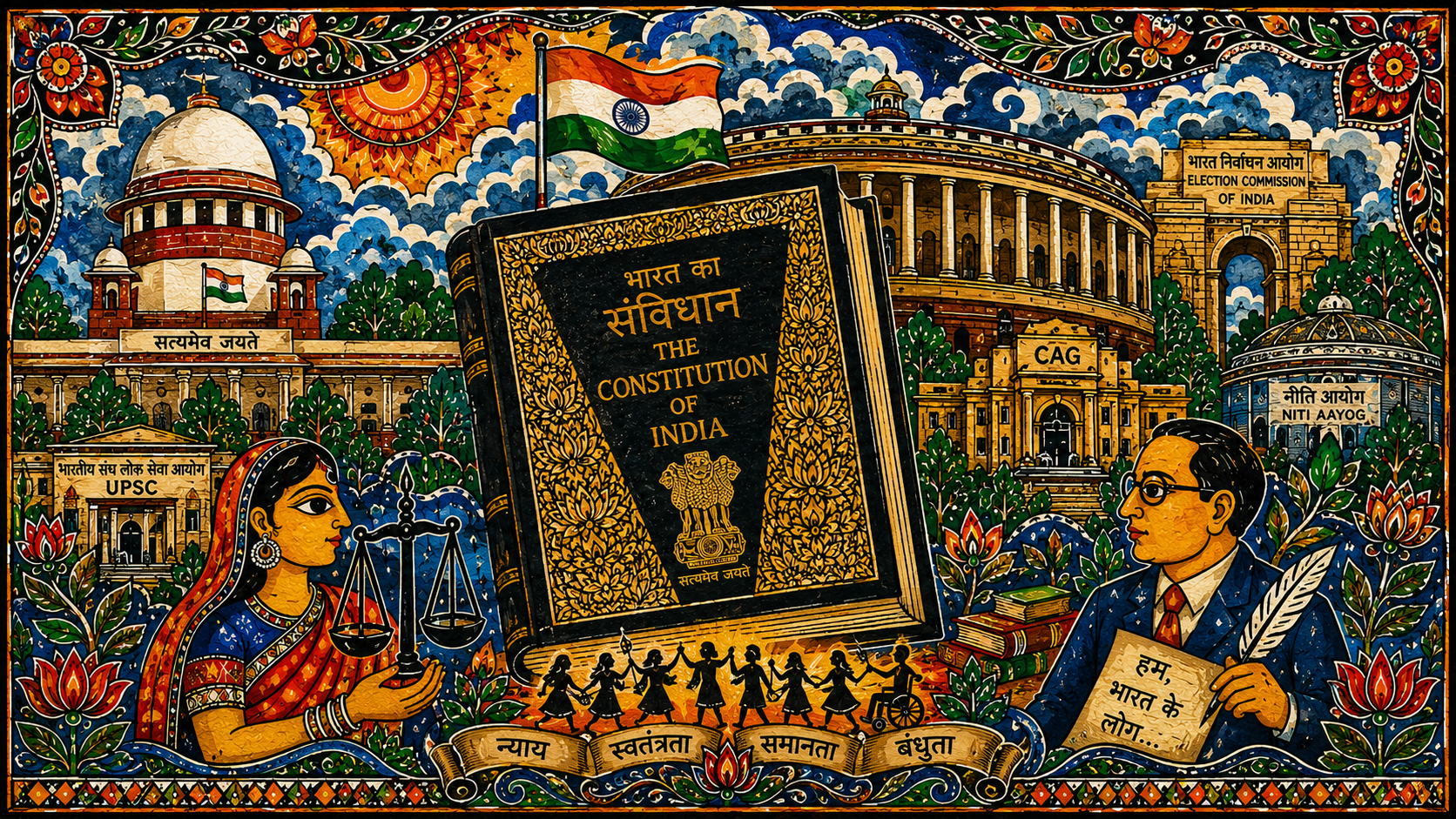
The Constitution of India, which came into force on 26 January 1950, is the lengthiest written constitution in the world. It did not emerge in a vacuum. Dr. B.R. Ambedkar, the principal architect of the Constitution, and the members of the Constituent Assembly drew upon the constitutional frameworks of numerous countries, tailoring borrowed provisions to suit India’s unique socio-political context. Understanding the sources of the Indian Constitution is essential for any serious student of constitutional law.
1. Government of India Act, 1935 — The Primary Source
The single most influential document in shaping the Indian Constitution was the Government of India Act, 1935. A substantial portion of the structural and administrative framework was borrowed from this Act, which is why critics sometimes called the Constitution a “carbon copy” of the 1935 Act — an exaggeration, but indicative of its influence.
Provisions borrowed:
- Federal structure of government
- Office of the Governor
- Judiciary structure, including the Federal Court
- Public Service Commissions
- Emergency provisions
- Administrative details
2. British Constitution
India’s colonial experience left a deep constitutional imprint. Several key features of parliamentary democracy were drawn from the United Kingdom’s unwritten constitution.
Provisions borrowed:
- Parliamentary form of government
- Rule of Law (Dicey’s concept)
- Legislative procedure and privileges of Parliament
- Bicameralism (two Houses of Parliament)
- Cabinet system and collective responsibility of the Council of Ministers
- Writs (habeas corpus, mandamus, certiorari, prohibition, quo warranto)
- Single citizenship
3. United States Constitution
The Constitution of the United States of America is the oldest written constitution in the world and provided a rich source of inspiration, particularly for fundamental rights and judicial review.
Provisions borrowed:
- Fundamental Rights (Part III)
- Independence of the Judiciary
- Judicial Review
- Preamble to the Constitution
- Removal of Supreme Court judges through impeachment
- Post of Vice-President
- Equal protection of laws
4. Irish Constitution (Éire, 1937)
The Irish Constitution was particularly influential given Ireland’s own experience as a newly independent nation that had recently freed itself from colonial rule — a parallel deeply resonant with India’s own struggle.
Provisions borrowed:
- Directive Principles of State Policy (Part IV) — the most significant borrowing
- Method of election of the President
- Nomination of members to the Rajya Sabha by the President
5. Canadian Constitution
The Canadian Constitution offered a federal model with a strong central government, which appealed to the framers given India’s diversity and the need for national unity.
Provisions borrowed:
- Quasi-federal features (strong Centre with residuary powers)
- Appointment of State Governors by the Centre
- Advisory jurisdiction of the Supreme Court
- Distribution of legislative powers between the Union and States
6. Australian Constitution
The Australian Constitution provided useful models for the concurrent list structure and inter-state trade provisions.
Provisions borrowed:
- Concurrent List (subjects on which both Parliament and State Legislatures can legislate)
- Freedom of trade, commerce, and intercourse among states
- Joint sitting of both Houses of Parliament to resolve deadlocks
7. Weimar Constitution of Germany (1919)
The Weimar Constitution of the German Republic, though historically ill-fated, contained progressive provisions that found their way into the Indian Constitution.
Provisions borrowed:
- Suspension of Fundamental Rights during Emergency
- Emergency provisions that allow federal features to be suspended
- Concept of a strong executive during national emergencies
8. South African Constitution
The Constitution of South Africa influenced the procedure for amending the Indian Constitution and provisions relating to the Council of States.
Provisions borrowed:
- Procedure for amendment of the Constitution (partly rigid, partly flexible)
- Election of members of the Rajya Sabha
9. Soviet Constitution (USSR, 1936)
The Constitution of the erstwhile Soviet Union influenced the socio-economic vision embedded in the Indian Constitution, particularly through Fundamental Duties and Directive Principles.
Provisions borrowed:
- Fundamental Duties (added by the 42nd Amendment, 1976, inspired by the Soviet model)
- Ideals of social, economic, and political justice in the Preamble
- Provisions relating to secularism and the welfare state
10. French Constitution
The French Constitution contributed to the liberty, equality, and fraternity ideals prominently placed in the Preamble of the Indian Constitution.
Provisions borrowed:
- Republic and the ideals of Liberty, Equality, and Fraternity
- Concept of a secular republic
11. Japanese Constitution (1946)
The Constitution of Japan influenced one significant provision in the Indian Constitution.
Provisions borrowed:
- Procedure established by law (Article 21 of the Indian Constitution — protection of life and personal liberty — draws from Japan’s due process-inspired language)
Summary Table
| Source Country / Document | Key Provisions Borrowed |
|---|---|
| Government of India Act, 1935 | Federal structure, Governor, Judiciary, Emergency provisions |
| United Kingdom | Parliamentary democracy, Rule of Law, Cabinet system, Writs |
| United States | Fundamental Rights, Judicial Review, Preamble, Impeachment |
| Ireland | Directive Principles, Presidential election method |
| Canada | Quasi-federal structure, Residuary powers with Centre |
| Australia | Concurrent List, Joint sitting of Parliament |
| Germany (Weimar) | Emergency provisions, Suspension of Fundamental Rights |
| South Africa | Constitutional amendment procedure |
| USSR | Fundamental Duties, Socio-economic justice |
| France | Ideals of Liberty, Equality, Fraternity; Secular Republic |
| Japan | Procedure established by law (Article 21) |
Critical Observations
1. Not Mere Borrowing: Although the Constituent Assembly drew extensively from foreign constitutions, it did not blindly transplant provisions. Each borrowed feature was debated, modified, and adapted to India’s ground realities — its diversity, history of colonialism, and socio-economic conditions.
2. The Colonial Inheritance: The heavy reliance on the Government of India Act, 1935, was pragmatic. The Act had been tested and its administrative machinery was already familiar to Indian civil servants and judges. Discarding it entirely would have caused institutional chaos.
3. Original Contributions: Several features of the Indian Constitution are genuinely original, including:
- The unique blend of rigidity and flexibility in the amendment procedure.
- Constitutional recognition of the Special Officer for Linguistic Minorities.
- Provisions for Scheduled Castes, Scheduled Tribes, and Other Backward Classes.
- A comprehensive list of Fundamental Rights enforceable against the State.
4. The Preamble as a Synthesis: The Preamble — “We, the People of India… Justice, Liberty, Equality and Fraternity” — represents a synthesis of Western liberal ideals, socialist aspirations, and Gandhian values, making it uniquely Indian despite its diverse intellectual ancestry.
Conclusion
The Indian Constitution is best understood not as a derivative document but as a creative synthesis. The framers were learned, pragmatic, and deeply conscious of India’s needs. They looked at the world’s best constitutional frameworks and took what was useful, rejected what was unsuitable, and created something that has endured for over seven decades. For law students and aspirants, mastering these sources is not merely an academic exercise — it is the foundation for understanding why every Article of the Constitution is drafted the way it is.