

I. Introduction
The Preamble to the Constitution of India is the opening statement that encapsulates the philosophy, ideals, and aspirations of the Constitution. It is not merely a decorative prefix — it is the soul of the Constitution, the mirror in which the framers’ vision for the new republic stands reflected.
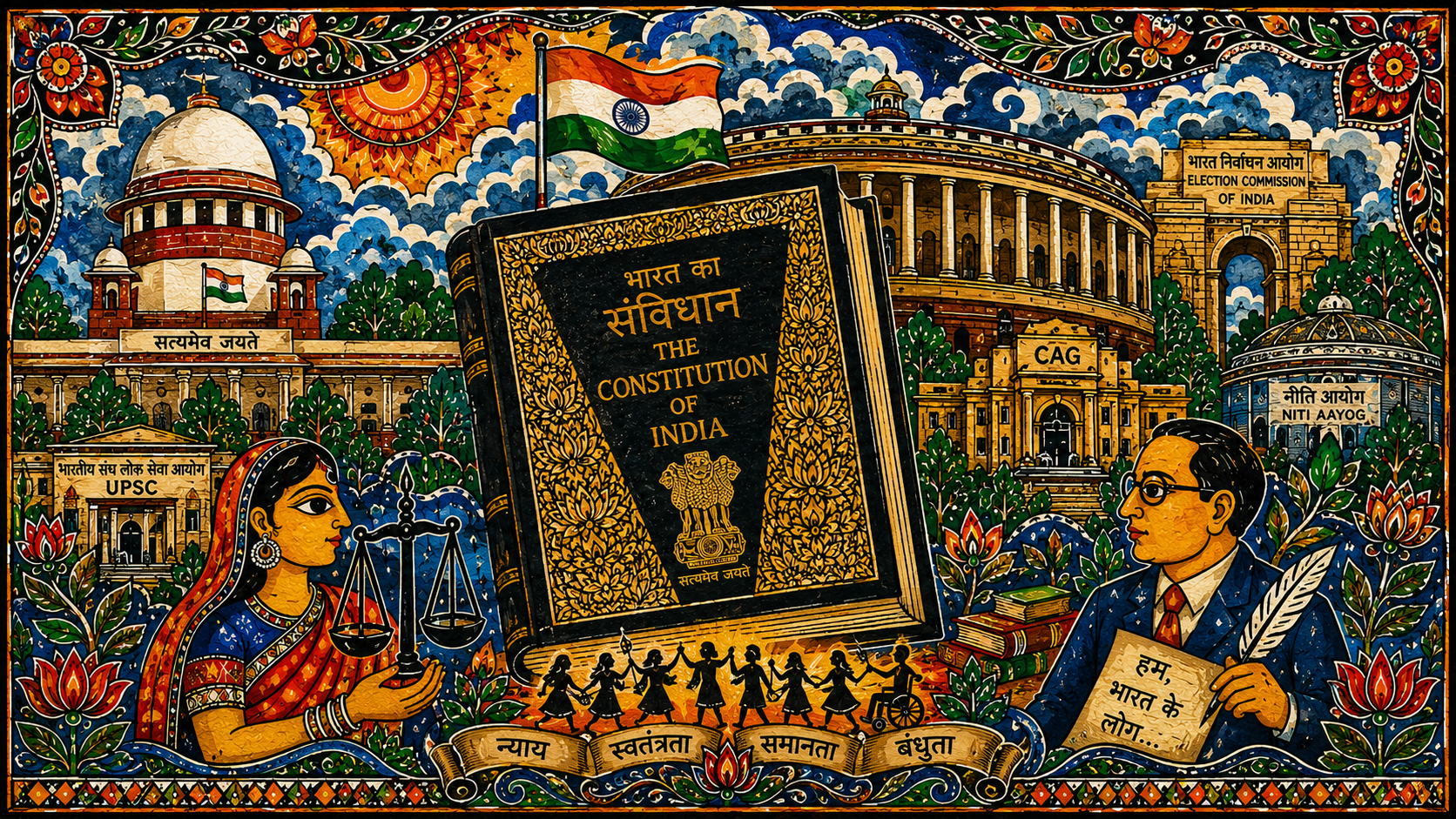
As Dr. B.R. Ambedkar observed, the Preamble contains the essence of the Constitution. It introduces the document, announces its source of authority, and declares the goals the Constitution seeks to achieve. For a law student or aspirant, a thorough understanding of the Preamble is non-negotiable as it forms the interpretive lens through which every constitutional provision must be read.
II. Text of the Preamble
“WE, THE PEOPLE OF INDIA, having solemnly resolved to constitute India into a SOVEREIGN SOCIALIST SECULAR DEMOCRATIC REPUBLIC and to secure to all its citizens:
JUSTICE, social, economic and political;
LIBERTY of thought, expression, belief, faith and worship;
EQUALITY of status and of opportunity; and to promote among them all
FRATERNITY assuring the dignity of the individual and the unity and integrity of the Nation;
IN OUR CONSTITUENT ASSEMBLY this twenty-sixth day of November, 1949, do HEREBY ADOPT, ENACT AND GIVE TO OURSELVES THIS CONSTITUTION.”
III. Meaning and Analysis of the Preamble
A. “We, the People of India”
This phrase is the cornerstone of popular sovereignty. It declares unambiguously that the Constitution does not derive its authority from the British Crown, any colonial statute, or a foreign power — it derives its authority from the people of India themselves. The Constituent Assembly acted as the representative body of the Indian people, and in that capacity gave the Constitution to themselves.
This stands in sharp contrast to Constitutions of some other nations, which were granted by monarchs or imposed by external authorities.
B. “Sovereign”
India is sovereign in both internal and external dimensions. Internally, it has the supreme authority to govern its territory and people without any interference. Externally, no foreign power has authority over India’s legislative, executive, or judicial functions. India’s membership in the United Nations or other international organizations does not derogate from its sovereignty — these are voluntary associations.
C. “Socialist”
The word “Socialist” was inserted by the 42nd Constitutional Amendment, 1976. It does not connote a rigid Marxist or communist model. The Indian conception of socialism is a democratic socialism — a mixed economy where private ownership coexists with state regulation and welfare-oriented governance. The Supreme Court has explained that Indian socialism aims at equality of opportunity, not equality of outcome, and seeks to eliminate exploitation.
D. “Secular”
Also inserted by the 42nd Amendment, 1976, “Secular” means that the Indian State has no official religion. The State treats all religions equally — it neither favours nor discriminates against any religion. Articles 25 to 28 of the Constitution guarantee freedom of religion, while the State retains the power to regulate secular activities associated with religious practice.
Indian secularism is distinct from Western secularism — it is not the exclusion of religion from public life, but a principled equidistance of the State from all religions.
E. “Democratic”
India is a representative democracy — the people govern themselves through elected representatives. The Constitution guarantees universal adult franchise (Article 326), free and fair elections, and a multi-party system. Democracy here encompasses not just political democracy but also social and economic democracy, as Dr. Ambedkar repeatedly emphasized.
F. “Republic”
India is a republic because its head of state — the President — is an elected office, not a hereditary one. This distinguishes India from constitutional monarchies like the United Kingdom or Canada.
G. Justice — Social, Economic and Political
- Social Justice: Elimination of discrimination based on caste, religion, gender, race, etc. Reflected in Articles 14–18, reservations, and protective legislation.
- Economic Justice: Equitable distribution of resources; no concentration of wealth. Reflected in the Directive Principles, particularly Articles 39, 41, and 43.
- Political Justice: One person, one vote; equal participation in the political process. Reflected in Article 326.
H. Liberty
Liberty encompasses freedom of thought, expression, belief, faith, and worship. It is the bedrock of individual autonomy. Articles 19, 20, 21, and 25 give concrete form to these liberties. However, liberty under the Indian Constitution is not absolute — it is subject to reasonable restrictions in the interest of public order, morality, and the rights of others.
I. Equality
Equality of status and opportunity means that all citizens stand equal before the law and have equal access to opportunities. Articles 14–18 operationalize this goal. Importantly, equality does not mean identical treatment — substantive equality allows for affirmative action in favour of historically disadvantaged groups.
J. Fraternity
Fraternity is the emotional bond that holds a diverse nation together. It assures the dignity of the individual and the unity and integrity of the Nation. Without fraternity, justice, liberty, and equality remain hollow slogans. This concept, borrowed from the French Revolution, finds expression in the constitutional prohibitions on untouchability (Article 17) and the fundamental duties (Article 51A).
IV. The Objective Resolution — The Genesis of the Preamble
What Was the Objective Resolution?
The Objective Resolution was a historic document moved by Jawaharlal Nehru in the Constituent Assembly on 13 December 1946 and unanimously adopted on 22 January 1947. It was the foundational blueprint that guided the framing of the Constitution and eventually crystallized into the Preamble.
Text of the Objective Resolution (Key Clauses)
- India shall be an Independent Sovereign Democratic Republic.
- All power and authority of the Sovereign Independent India shall flow from the people.
- All people of India shall be guaranteed and secured social, economic, and political justice; equality of status and opportunity; and freedom of thought, expression, belief, faith, worship, vocation, association, and action, subject to law and public morality.
- Adequate safeguards shall be provided for minorities, backward and tribal areas, and depressed and backward classes.
- The integrity of the territory of the Republic and its sovereign rights on land, sea, and air shall be maintained.
- This ancient land shall attain its rightful and honoured place in the world and make its full and willing contribution to the promotion of world peace and the welfare of mankind.
Relationship Between the Objective Resolution and the Preamble
The Preamble is the distilled, formal expression of the Objective Resolution. While the Resolution was a political declaration made in the early stages of constitution-making, the Preamble is the legally adopted version that appears as part of the Constitution. The key values — sovereignty, democracy, justice, liberty, equality, fraternity — flow directly from the Resolution.
The Supreme Court has recognized that the Preamble reflects the aims and aspirations of the people as articulated in the Objective Resolution, and is a key to the minds of the makers of the Constitution.
V. Is the Preamble a Part of the Constitution?
This question has been a subject of deep judicial controversy.
Early Position — In re Berubari Union Case (1960)
In re Berubari Union, AIR 1960 SC 845
Facts: The President sought the Supreme Court’s advisory opinion on whether the Indo-Pakistan Agreement of 1958 (relating to the exchange of the Berubari Union territory) could be implemented without a constitutional amendment.
Held: The Supreme Court, in its advisory opinion, observed that the Preamble is not a part of the Constitution. The Court stated that the Preamble is the “key to open the minds of the makers” but cannot be regarded as a source of any substantive power or limitation.
Significance: This was the prevailing view for over a decade — the Preamble was regarded as a mere introductory statement with persuasive but no binding legal value.
The Turning Point — Kesavananda Bharati v. State of Kerala (1973)
Kesavananda Bharati v. State of Kerala, AIR 1973 SC 1461
Facts: Swami Kesavananda Bharati, the head of a religious mutt in Kerala, challenged the Kerala Land Reform Acts, which sought to acquire properties belonging to the mutt. The case expanded into a monumental constitutional challenge concerning the extent of Parliament’s amending power under Article 368. A 13-judge Constitution Bench was constituted — the largest ever in Indian judicial history.
Held (by majority, 7:6): The Supreme Court overruled the Berubari decision on the status of the Preamble and held that the Preamble is a part of the Constitution. The Court further enunciated the Basic Structure Doctrine — that Parliament, while it may amend any part of the Constitution under Article 368, cannot abrogate or destroy the basic structure or essential features of the Constitution.
Key observations on the Preamble:
- The Preamble reflects the basic structure of the Constitution.
- Sovereign, democratic, republican character; justice, liberty, equality, and fraternity — these are elements of the basic structure.
- Parliament cannot, even by a constitutional amendment, destroy these foundational values.
Significance: This is the single most important constitutional judgment in Indian history. It resolved the Preamble debate conclusively and simultaneously created the most powerful limitation on parliamentary power — the Basic Structure Doctrine.
VI. Amendability of the Preamble
The Core Question
Can Parliament amend the Preamble under Article 368? This question is intertwined with the Basic Structure Doctrine. Two sub-questions arise:
- Is the Preamble amendable at all?
- If yes, to what extent?
The 42nd Amendment, 1976 — A Practical Answer
In 1976, during the Emergency, Parliament amended the Preamble by inserting the words “Socialist,” “Secular,” and “Integrity” through the Constitution (42nd Amendment) Act, 1976. This was the first and only amendment to the Preamble.
This amendment settled one part of the debate: Parliament treated the Preamble as amendable under Article 368, and the amendment was accepted without the Supreme Court striking it down on the ground that the Preamble is non-amendable.
Judicial Position on Amendability
Kesavananda Bharati (1973) — The Framework
The Kesavananda Bharati judgment established that:
- The Preamble can be amended under Article 368.
- However, the basic features reflected in the Preamble cannot be destroyed by any amendment.
- Sovereign, democratic, republic character and the core values of justice, liberty, equality, fraternity are basic features — inviolable.
In essence: the Preamble is amendable in form but not in substance to the extent it embodies basic structure elements.
S.R. Bommai v. Union of India (1994)
S.R. Bommai v. Union of India, AIR 1994 SC 1918
Facts: This landmark case arose out of the dismissal of several state governments under Article 356 (President’s Rule) — including the BJP governments in Madhya Pradesh, Rajasthan, and Himachal Pradesh — following the demolition of the Babri Masjid in December 1992. The dismissed governments challenged the Presidential Proclamations.
Held: The Supreme Court upheld Secularism as a basic feature of the Constitution. The Court ruled that:
- A government that acts against secularism acts against the Constitution.
- The use of religion for electoral gains is unconstitutional.
- Courts can examine whether the material before the President justifies the proclamation under Article 356.
Relevance to the Preamble: The Court extracted the principle of secularism directly from the Preamble and Articles 25–28 and elevated it to the status of a basic structure. This means Parliament cannot amend the Constitution to make India a theocratic state.
Significance: S.R. Bommai is the judicial sentinel of Indian secularism. It gives the Preamble’s declaration of secularism a concrete, enforceable dimension.
Excel Wear v. Union of India (1978)
Excel Wear v. Union of India, AIR 1979 SC 25
Facts: The petitioners challenged the Industrial Disputes Act’s provisions restricting closure of industrial undertakings, arguing they violated their fundamental rights. The question arose as to whether “socialist” in the Preamble (inserted by the 42nd Amendment) could be used to curtail property rights.
Held: The Court held that while the socialist objective must inform the interpretation of the Constitution, it cannot be used to override fundamental rights entirely. The socialist ideal must be harmoniously reconciled with individual rights.
Significance: This case demonstrates that the Preamble’s goals — while interpretively significant — operate within the framework of the Constitution’s balance between individual rights and state welfare. The Preamble does not permit totalitarian suppression of rights in the name of socialism.
LIC of India v. Consumer Education & Research Centre (1995)
LIC of India v. Consumer Education & Research Centre, AIR 1995 SC 1811
Facts: The case involved the question of whether the terms and conditions of LIC service rules and insurance policies violated consumer rights and constitutional principles.
Held: The Supreme Court invoked the Preamble’s goal of social and economic justice and held that in a welfare state, the State must act in the interest of the people. Economic justice, as enshrined in the Preamble and the Directive Principles, must guide State action.
Significance: This case illustrates the Preamble being used as a positive interpretive tool to read welfare obligations into the actions of State instrumentalities.
Union of India v. Madan Gopal Kabra (1954)
Union of India v. Madan Gopal Kabra, AIR 1954 SC 158
Held: The Supreme Court used the Preamble’s declaration of liberty and equality to interpret the scope of fundamental rights under Articles 19 and 14. The Court observed that the Constitution’s text must be read in light of the overarching goals declared in the Preamble.
Significance: One of the early cases affirming the Preamble’s role as an interpretive instrument, even before its status as a constitutional part was settled.
VII. The Preamble and the Basic Structure Doctrine — The Synthesis
The relationship between the Preamble and the Basic Structure Doctrine can be summarized as follows:
| Element of Preamble | Status under Basic Structure |
|---|---|
| Sovereignty | Basic Structure — cannot be destroyed |
| Democracy | Basic Structure |
| Republic | Basic Structure |
| Secularism | Basic Structure (S.R. Bommai) |
| Socialism (democratic form) | Part of basic structure in welfare sense |
| Justice (social, economic, political) | Informs basic structure |
| Liberty | Informs basic structure |
| Equality | Basic Structure (Article 14) |
| Fraternity/Dignity | Basic Structure (human dignity) |
| Unity and Integrity | Basic Structure |
The Basic Structure Doctrine, born in Kesavananda Bharati, draws its oxygen from the Preamble. Every element the Court has recognized as basic structure traces back to the Preamble’s language.
VIII. Role of the Preamble in Constitutional Interpretation
The Supreme Court has consistently used the Preamble as an interpretive guide when constitutional provisions are ambiguous. Key principles:
- Key to the Constitution: The Preamble opens the minds of the makers and reveals their intention.
- Aids in resolving ambiguity: When a provision of the Constitution is capable of two interpretations, the one consistent with the Preamble’s values must be preferred.
- Not an independent source of power: The Preamble cannot confer powers not found elsewhere in the Constitution, nor can it directly create enforceable rights.
- Limits on amendment: The Preamble marks the outer boundary of Parliament’s amending power under Article 368.
IX. Summary Table — Key Case Laws
| Case | Year | Key Ruling |
|---|---|---|
| In re Berubari Union | 1960 | Preamble is NOT a part of the Constitution |
| Kesavananda Bharati v. State of Kerala | 1973 | Preamble IS a part of the Constitution; Basic Structure Doctrine |
| S.R. Bommai v. Union of India | 1994 | Secularism is a Basic Structure; Preamble directly invoked |
| Excel Wear v. Union of India | 1978 | Socialism in Preamble must be balanced with fundamental rights |
| LIC v. Consumer Education & Research Centre | 1995 | Preamble’s economic justice used to impose welfare duties on State |
| Union of India v. Madan Gopal Kabra | 1954 | Preamble used as interpretive guide for fundamental rights |
X. Conclusion
The Preamble to the Constitution of India is far more than a ceremonial introduction. It is the constitutional conscience — the statement of values that animates every provision of the document. From being dismissed as a non-enforceable preamble in the Berubari case to being recognized as the source of the Basic Structure in Kesavananda Bharati, the judicial journey of the Preamble reflects the maturing of Indian constitutionalism.
The Objective Resolution, moved by Nehru in 1946, gave the Preamble its soul. The 42nd Amendment gave it two more defining adjectives — Socialist and Secular. The Basic Structure Doctrine gave it teeth. And decades of Supreme Court jurisprudence have given it life.
For any student of Indian constitutional law, the Preamble is not a paragraph to be memorized — it is a philosophy to be understood, internalized, and invoked.